Digital nomad international calls are not a luxury — they are infrastructure. Whether you are closing a client deal from a Lisbon co-working space, calling your bank's fraud department from a Bali villa, or checking in with family in Toronto while your UK mobile roams at €2 per minute, you need voice connectivity that follows your laptop, not your SIM contract. The nomad lifestyle breaks every assumption traditional carriers built their pricing around: fixed home country, predictable monthly minutes, and callers who stay in one timezone.
Ringvoo gives location-independent workers a browser-based international dialer that runs on any Wi-Fi connection worldwide. No app store region locks, no expiring Skype credit, no swapping SIM cards at every border. This guide covers the calling stack nomads actually use in 2026, how to avoid roaming traps, and how to reach any mobile or landline from a browser tab in under five minutes.
Key Takeaways
- Browser VoIP over Wi-Fi is the default for nomads who call banks, clients, and landlines — free messaging apps cannot replace PSTN.
- Roaming on your home-country SIM is the most expensive option for regular international voice — see roaming vs browser calling.
- You do not need a local SIM to place outbound international calls — internet plus a browser dialer is enough.
- Pay-as-you-go credits beat subscriptions when your destinations and volume change every month.
- Build a full savings strategy with how expats save on international calls.
The Digital Nomad Calling Problem
Traditional phone service assumes you live where your SIM is registered. Digital nomads violate that assumption weekly.
Roaming surcharges: A UK EE or US T-Mobile plan that includes "international calling" often means international from your home country — not from Thailand, Portugal, or Mexico. Outbound calls while roaming can trigger per-minute fees of $1–3 or more.
Local SIM limitations: Buying a SIM in each country gives you cheap local data but does not help you call a German client's landline or your US credit union's verification line. You still need international PSTN outbound.
App-only solutions fail: WhatsApp and Telegram work for contacts who share the app. They cannot dial Chase Bank, HMRC, a pharmacy in Ohio, or your grandmother's landline in Kerala.
Skype legacy: Many nomads still search for Skype credit replacements. Consumer Skype is winding down — browser VoIP is the modern path.
Time zone chaos: You may need to call London at 9 AM GMT from Chiang Mai at 4 PM — carrier business hours and client expectations do not adjust for your beach schedule.
The solution is a location-agnostic calling layer that uses internet connectivity and terminates on the global phone network. That is exactly what browser pay-as-you-go VoIP provides.
The Nomad Calling Stack — What to Use When
| Scenario | Best method | Why |
|---|---|---|
| Call client landline abroad | Browser VoIP (Ringvoo) | PSTN reach, transparent rates |
| Video chat with fellow nomad | Zoom, Meet, WhatsApp | Free, both on app |
| Call home bank / government | Browser VoIP | IVR and DTMF need PSTN |
| Receive client callbacks | Virtual number | Professional inbound identity |
| Emergency local services | Local SIM cellular | VoIP is not for 112/911 |
| Short data-only trip | eSIM data + browser VoIP | No physical SIM swap |
Most nomads run a hybrid stack: eSIM or local SIM for data and emergencies, browser VoIP for outbound international PSTN, free apps for peer-to-peer video. Avoid relying on a single home-country SIM for everything — that is how €200 roaming bills happen.
Browser VoIP — The Nomad Default
Browser calling requires no install — critical when you are on a borrowed laptop, a Chromebook, or a phone you do not want to clutter with single-purpose apps.
How it works on the road:
- Connect to co-working, hotel, or café Wi-Fi (or mobile hotspot from your eSIM).
- Open Ringvoo in Chrome or Safari.
- Enter the destination number in E.164 format (
+1,+44,+91, etc.). - Call — audio routes through carrier interconnects to a normal phone.
Advantages for nomads:
- Works in any country with internet — Thailand, Georgia, Colombia, Portugal.
- Credits do not expire when you skip a month of calling.
- Per-destination rates visible before you dial — no post-trip bill shock.
- Same account on laptop, tablet, and phone browser — no device sync issues.
Limitations:
- Requires stable internet — carry a mobile hotspot backup for critical calls.
- Some co-working firewalls block WebRTC — switch to hotspot if audio fails.
- Not for local emergency numbers — keep a SIM or know local emergency access.
Deep dive: international calls without a SIM and what is browser calling.
Roaming vs Browser Calling — Why Nomads Switch
Home-country carriers market "international included" plans that rarely cover the nomad use case. When you are physically in Bali calling a US 800-number replacement line, you are often paying roaming outbound international rates — among the worst pricing tiers in telecom.
| Factor | Home SIM roaming | Browser VoIP on Wi-Fi |
|---|---|---|
| Cost per minute to US/UK/EU | Often $1–3+ | Cents — check rates |
| Requires home carrier active | Yes | No — internet only |
| Calls any PSTN number | Yes, expensively | Yes, at VoIP rates |
| Bill predictability | Poor — surprises common | Prepaid credits, visible rates |
| Works when SIM deactivated | No | Yes |
Read the full comparison: roaming vs browser calling.
Rule of thumb: Disable international roaming on your home SIM for voice. Use it for data if the plan is cheap, or buy local/eSIM data. Place PSTN calls through browser VoIP.
eSIMs, Local SIMs, and Virtual Numbers
Nomads often combine three number types:
eSIM for data: Airalo, Holafly, or carrier travel eSIMs provide data without physical swaps. Pair with browser VoIP for voice outbound.
Local SIM for longevity stays: Three-month stays in one country may justify a local number for rideshare, delivery, and local contacts. Keep browser VoIP for international outbound.
Virtual number for inbound: If clients or banks must call you back on a US or UK number, a virtual phone number routed to your browser inbox preserves professional identity. Essential for freelancers billing US or EU clients.
Do not confuse a virtual number with a calling solution — it solves inbound identity; browser VoIP solves outbound PSTN at low cost.
Call internationally from anywhere with Ringvoo
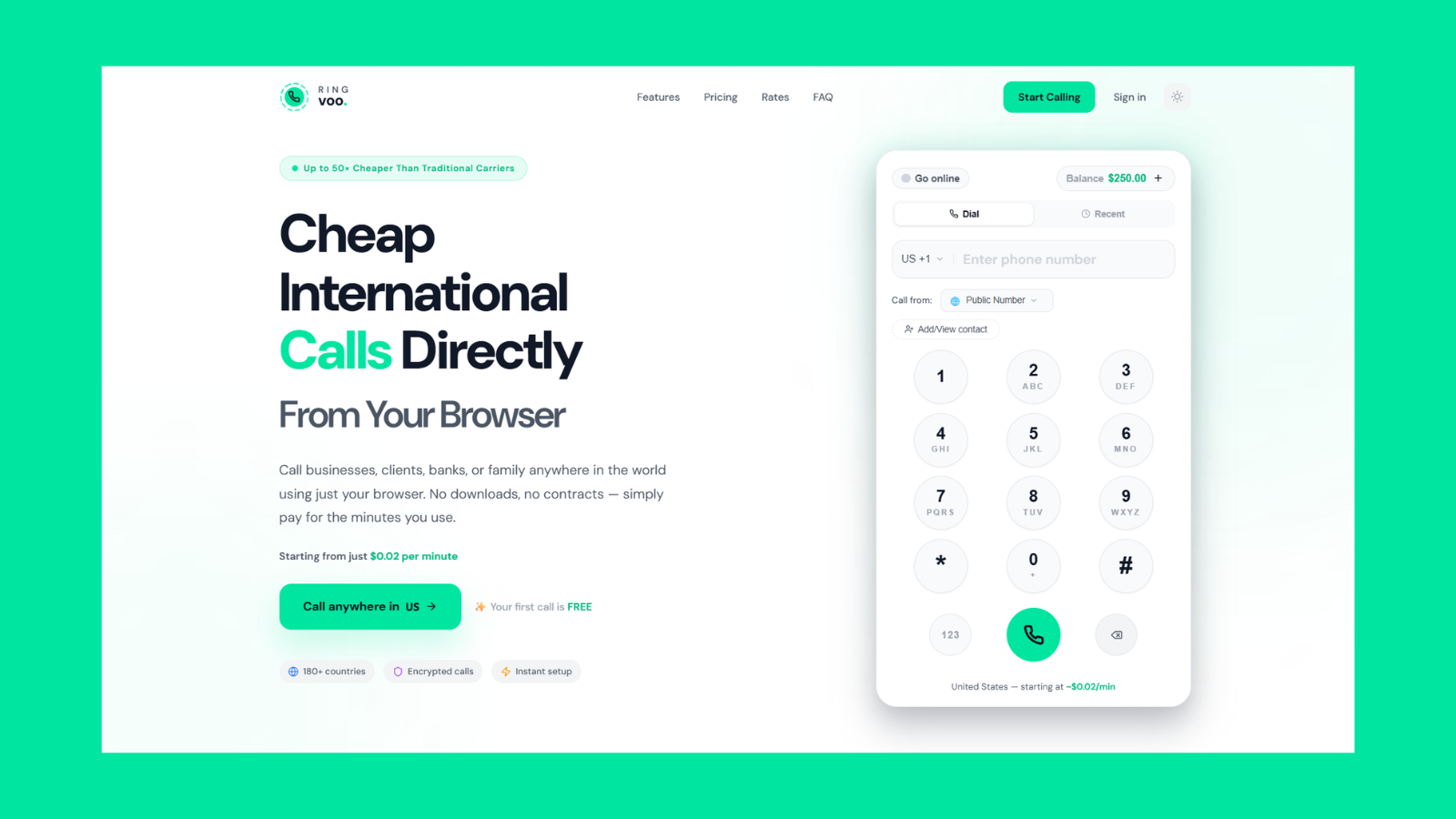
Ringvoo is built for location-independent callers. Log in from Lisbon, Bali, or Medellín, dial any mobile or landline worldwide, and pay only for minutes used. No subscription, no roaming, no app download.
Try Ringvoo free — call from your browser · View international rates
Country-Hopping Workflows That Actually Work
The monthly mover (new country every 4–6 weeks)
- eSIM data plan or local prepaid SIM for connectivity.
- Ringvoo bookmarked for all PSTN outbound — banks, clients, family landlines.
- WhatsApp for nomad friends and free video.
- Home SIM on airplane mode or data-only to avoid roaming voice.
The slowmad (3+ months per base)
- Local SIM for daily life and emergency calls.
- Browser VoIP for international client and family PSTN.
- Optional virtual number if clients expect a fixed US/UK callback line.
Cost Control for Nomads Who Call Weekly
Nomads who call home or clients several times per week should audit spending monthly:
- List your top three destinations — e.g. US, India, UK.
- Estimate monthly minutes per destination.
- Multiply by Ringvoo rates for VoIP cost.
- Compare to roaming quotes from your home carrier — usually 5–20× higher.
- Keep free apps for app-to-app video — do not pay VoIP for what WhatsApp handles free.
For broader frameworks, see how expats save on international calls and cheapest way to call abroad in 2026.
Avoid: Hotel room phones for international PSTN — surcharges routinely exceed VoIP by an order of magnitude. Avoid: Airport SIM "international bundles" priced for tourists without comparing per-minute math.
Practical Tips — Audio, Security, and Time Zones
Audio quality: Use wired earbuds with a mic in noisy co-working spaces. Test call quality on a local number before a 45-minute client meeting.
Security: Enable two-factor authentication on your VoIP account. Use HTTPS-only login. For banking calls on public Wi-Fi, consider VPN if your bank recommends it.
Time zones: Store client and family time zones in your calendar. UAE is four hours ahead of UK; US East Coast is five to nine hours behind Western Europe depending on daylight saving.
DTMF tones: IVR menus (press 1 for accounts) require a dialer that sends keypad tones reliably — browser VoIP through Ringvoo supports this; some free apps do not.
Backup plan: If Wi-Fi fails mid-call, reconnect and redial. For mission-critical calls, have a mobile hotspot ready before you dial.
Frequently Asked Questions
How do digital nomads call internationally without roaming?
Use browser VoIP over Wi-Fi or mobile data. Log into Ringvoo, enter the full international number, and call — no home carrier roaming involved.
Do I need a SIM card to make international calls while traveling?
No for outbound PSTN via browser VoIP — internet is sufficient. You may still want a SIM or eSIM for data and local emergencies.
Is WhatsApp enough for nomads?
For nomad-to-nomad video, yes. For banks, government, clients on landlines, and family without smartphones — no. You need PSTN connectivity.
What replaced Skype for nomads?
Browser pay-as-you-go VoIP like Ringvoo — no download, no Microsoft account, credits that do not expire. See best Skype alternatives.
Can I use Ringvoo on co-working Wi-Fi?
Usually yes. If WebRTC is blocked, switch to mobile hotspot. Test with a short call before important meetings.
How do nomads receive international calls?
With a virtual number assigned to your account — calls ring in your browser. See receive calls in browser.
Is browser calling legal in countries that restrict VoIP?
Rules vary. Personal international calling is widely permitted; some countries limit VoIP for residents. Verify local regulations for long stays.
What is cheaper — eSIM data plus VoIP or roaming voice?
Almost always eSIM or local data plus browser VoIP for PSTN calls. Roaming voice is the premium-priced legacy option.
Build Your Nomad Calling Setup Today
The best international calling setup for digital nomads is deliberately boring: eSIM or local data for connectivity, browser pay-as-you-go VoIP for every PSTN call, free apps for peer video, and a virtual number only if inbound identity matters. Roaming voice on your home SIM should be the emergency fallback — not the default.
Stop overpaying at borders. Read how expats save on international calls, compare roaming vs browser calling, check live rates, and create your free Ringvoo account before your next country hop.