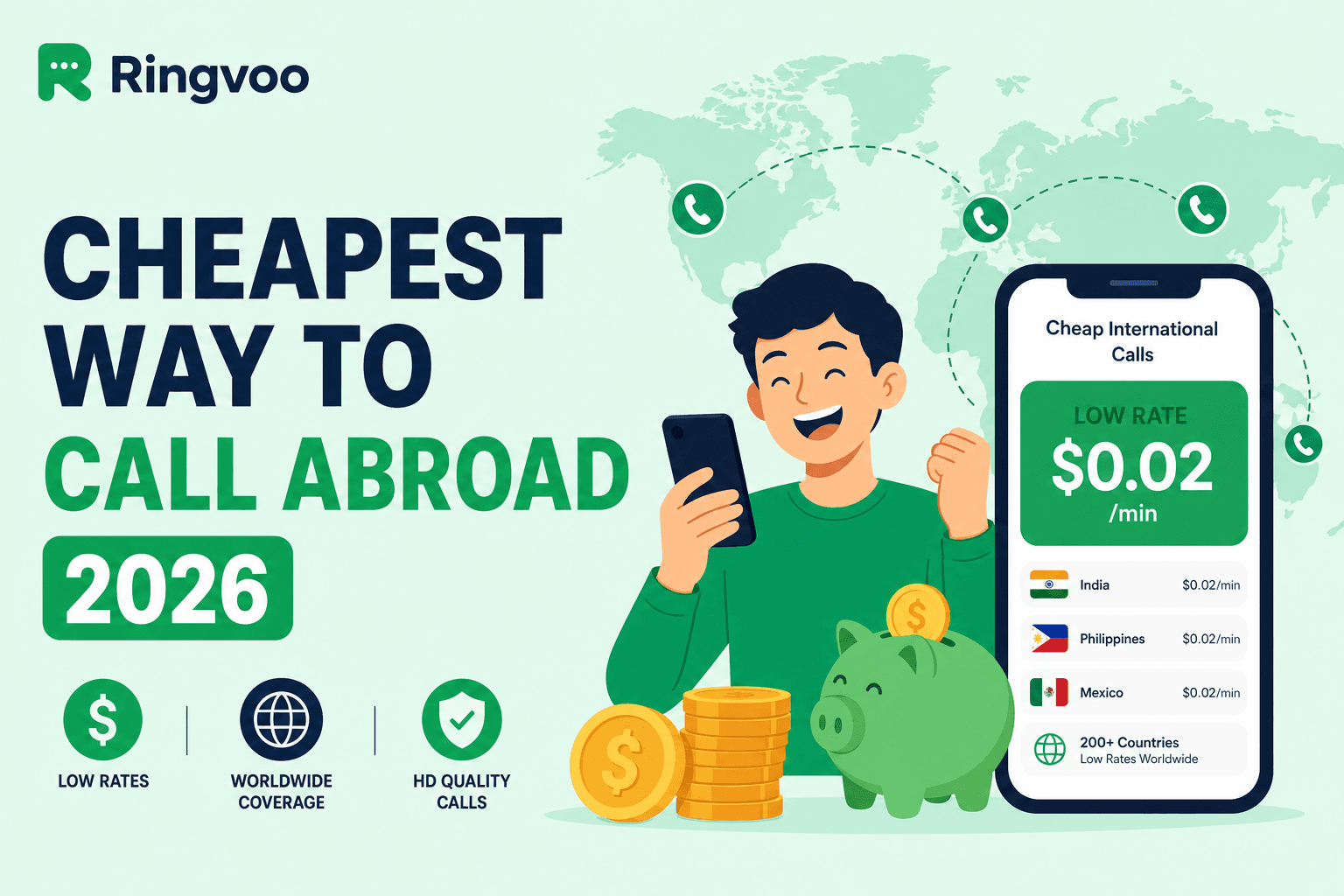
The cheapest way to call abroad in 2026 depends on three variables: where you are calling from, where you are calling to, and whether the other person must answer a normal phone or can meet you inside an app. There is no single winner for every scenario—carrier roaming wins nowhere except emergencies, free apps win for app-to-app video, and browser-based pay-as-you-go platforms like Ringvoo win for most expats, travelers, and remote workers who dial landlines, mobiles, and support hotlines weekly.
This guide compares methods honestly, shows real trade-offs in tables, explains hidden costs, and gives decision frameworks so you pick the cheapest option for your call pattern—not whatever app advertised loudest this month.
Key Takeaways
- Free messaging apps are cheapest only when both parties use the same app; they do not replace calls to banks, businesses, or relatives on landlines.
- Browser pay-as-you-go calling typically offers the lowest cost per minute to most international destinations with no monthly subscription.
- Carrier international packs and roaming are convenient but rarely the cheapest for regular callers; audit your bill before renewing add-ons.
- Virtual numbers add monthly cost but save on callbacks and professional presence—worth it only when inbound identity matters.
- Check rates by destination before long calls; mobile vs. landline pricing differs in many countries.
How International Calling Pricing Works in 2026
Every method eventually pays a carrier somewhere to terminate the call on the public telephone network (PSTN). Retail prices differ based on:
Retail markup over wholesale termination rates.
Subscription vs. pure usage business models.
Billing increments (per second vs. per minute rounding).
Connection or setup fees on legacy products.
Bundled minutes that expire unused.
Premium routes to toll-free, satellite, or rural prefixes.
The cheapest retail option minimizes fixed monthly fees when your volume is variable and publishes transparent per-destination pricing before you dial—Ringvoo's rates section embodies that model.
Method 1: Free Messaging and Video Apps
WhatsApp, Telegram, Signal, FaceTime, and Messenger offer free voice/video over data between app users.
Cost: $0 marginal on Wi-Fi or mobile data.
Limitation: Cannot dial ordinary phone numbers. Grandma's landline, your bank's IVR, and your client's office line are out of scope.
Quality: Excellent on good Wi-Fi; degrades on congested mobile data.
Best for: Friends and family who live in the same app ecosystem and do not need PSTN reach.
If more than thirty percent of your international communication targets non-app numbers, free apps cannot be your only strategy—pair them with a PSTN-capable service.
Method 2: Cellular Roaming and Carrier International Plans
Your mobile carrier may offer:
Daily roaming passes.
Monthly international bolt-ons.
"Included" minutes to select countries.
Cost: Often $10–$50+ monthly plus overages; roaming voice can exceed $1–$3/minute outside packs.
Advantage: Works without Wi-Fi; uses your existing number as caller ID.
Disadvantage: Poor value for frequent or long calls; fair-use limits; destination lists exclude countries you actually call.
Audit last quarter's usage. If you average under sixty minutes monthly to one corridor, pay-as-you-go browser calling almost always wins—see how expats save money on international calls.
Method 3: Legacy VoIP Subscriptions (Skype and Alternatives)
Skype and similar services popularized cheap international dialing. In 2026 the landscape shifted: subscriptions, credit packs, and Microsoft ecosystem changes pushed users toward alternatives.
Cost: $3–$15/month subscriptions plus per-minute on some routes, or expiring credit packs.
Advantage: Familiar dial pads; PSTN reach.
Disadvantage: Subscription creep; credits that expire; app-heavy experience.
Our best Skype alternatives in 2026 guide compares migration paths. Browser-native options reduce install friction.
Method 4: International Calling Apps (Mobile-Centric)
Dedicated Android/iOS apps advertise ultra-low rates to specific corridors (Gulf to South Asia, US to Latin America, etc.).
Cost: Competitive on advertised routes; sometimes hidden connection fees.
Advantage: Mobile-first UX; marketing rates can be very low on top destinations.
Disadvantage: Quality varies; privacy policies differ; some rely on aggressive ads; not all offer browser access or inbound numbers.
Compare holistically in best international calling apps—match apps to your destination list, not banner ads.
Method 5: Browser-Based Pay-As-You-Go (Ringvoo)
Ringvoo routes calls through your browser via WebRTC to PSTN destinations worldwide.
Cost: $0 monthly platform fee; pay per minute at published rates; credits never expire.
Advantage: No install; transparent rates; call any phone number; dashboard history; optional virtual numbers and inbound browser answering.
Disadvantage: Requires internet; toll-free quirks same as any VoIP origin.
Best for: Expats, remote workers, travelers with Wi-Fi, anyone calling landlines/support lines regularly.
Sign up free, add credits via Stripe when needed, dial from laptop or phone browser.
Method 6: Calling Cards and PIN Dialers
Physical and digital calling cards still exist, especially in diaspora retail channels.
Cost: Advertised "1000 minutes" rarely equals reality after fees and rounding.
Advantage: Cash purchase options in some markets.
Disadvantage: Opaque billing; no call history; customer support weak; PIN entry friction.
Digital wallet credits on reputable platforms supersede cards for most users in 2026.
Method 7: Local SIM in Destination Country
Buying a SIM where you travel gives local rates for domestic calls in that country—not automatically cheap calls home.
Cost: SIM price + top-ups; cheap in-country, international from that SIM varies.
Advantage: Local data and local caller ID while visiting.
Disadvantage: Does not solve calling your home country unless that SIM's international rates are good.
Useful for multi-month stays; pair with browser calling home via international calls without a SIM on your primary device.
The affordable way to call abroad: Ringvoo
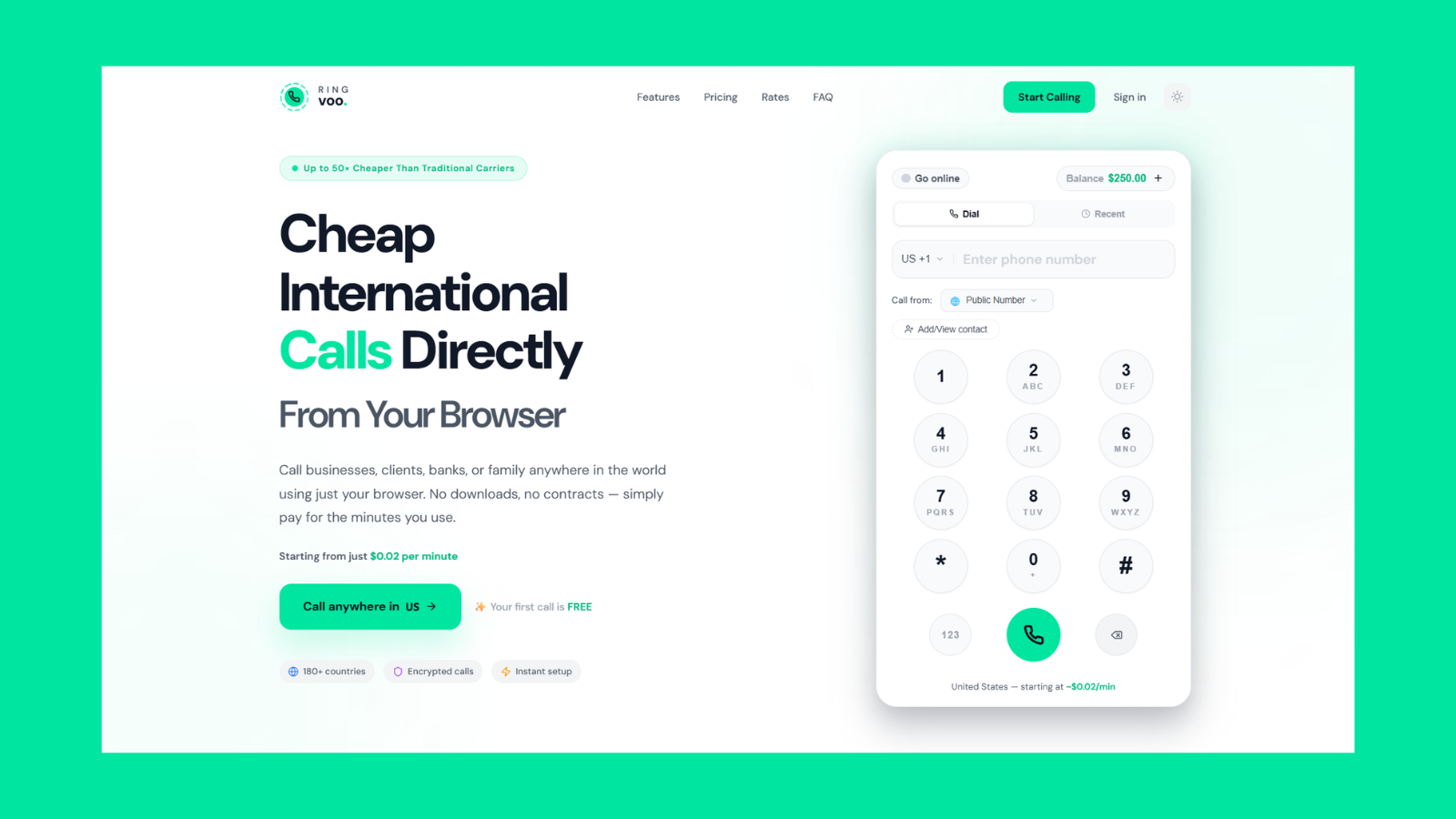
For most destinations, Ringvoo offers among the cheapest way to call abroad options that still reach landlines. Check live rates and pay only for minutes you use.
Try Ringvoo free — call from your browser · View international rates
Method 8: Virtual Numbers Plus Outbound
Adding a monthly virtual number increases fixed cost but can reduce total spend when callbacks, SMS 2FA, and local presence prevent expensive workarounds.
Cost: Monthly number fee + inbound/outbound usage.
Best for: Freelancers, small business, expats with bank callback requirements.
See our virtual phone number guide before buying numbers you do not need.
Master Comparison: Cheapest Way to Call Abroad by Scenario
| Scenario | Cheapest method | Runner-up | Avoid |
|---|---|---|---|
| Video chat with app-using friend | WhatsApp/FaceTime on Wi-Fi | — | Roaming voice |
| Daily calls to parents' mobile abroad | Browser pay-as-you-go (Ringvoo) | Corridor-specific app | Carrier roaming |
| Bank/support toll-free from overseas | Browser to direct intl. line | Callback request | Hotel phone |
| Landline to rural area | Compare prefix rates; browser PG | Calling card | Assumed flat "country rate" |
| Two-month Europe trip, call US often | Browser + Wi-Fi | US virtual number inbound | Roaming packs |
| Business needing local caller ID | Virtual number + browser | Second SIM line | Spoofing apps |
| Emergency with no internet | Cellular roaming voice | — | Browser-only tools |
The table is a starting point—always multiply your monthly minutes by quoted rates for your exact destinations.
Detailed Cost Comparison Table (Illustrative Monthly)
Assumptions: 400 outbound minutes/month to mixed mobile/landline; no inbound number needed. Illustrative retail pricing—verify live rates before budgeting.
| Method | Fixed monthly | Usage (400 min) | Total est. | Credits expire? |
|---|---|---|---|---|
| Ringvoo (browser PAYG) | $0 | $4–$20* | $4–$20 | Never |
| Carrier intl. pack | $25 | $0–$15 overage | $25–$40 | Often monthly |
| Cellular roaming | $0 | $400–$1200+ | $400+ | N/A |
| VoIP subscription | $10 | $5–$15 | $15–$25 | Sometimes |
| Free apps (PSTN portion) | N/A | Cannot complete | — | — |
*Highly destination-dependent; India mobile at low cents/min vs. premium prefixes changes totals dramatically.
Hidden Costs That Destroy "Cheap" Deals
Minute rounding: A 61-second call billed as 2 minutes doubles effective rate on some services. Ringvoo rounds partial minutes up to the next full minute—plan concise endings.
Connection fees: $0.04 per call × fifty redials adds up during IVR misnavigation.
Expiring credits: Unused Skype or app credits vanish on renewal—sunk cost pushes bad renewals.
FX fees on top-ups: Your bank charges international transaction fees on credit loads atop call rates.
Toll-free and premium: "Call us free" lines may bill you premium from abroad.
Data charges: App calling on mobile data abroad without local SIM can cost more than voice minutes—use Wi-Fi for browser dialer sessions.
Decision Framework: Pick Your Cheapest Stack in 10 Minutes
Step 1: List top five called countries and mobile vs. landline split.
Step 2: Estimate monthly minutes per country.
Step 3: Look up Ringvoo rates for each; sum estimated spend.
Step 4: Compare to your carrier bill line items for international/voice roaming.
Step 5: If PSTN share under twenty percent, keep free apps for that slice; route rest through browser PAYG.
Step 6: If callbacks dominate, evaluate virtual numbers monthly fee against missed-call chaos.
Step 7: Cancel redundant subscriptions discovered in audit.
Repeat quarterly—calling patterns change when family moves, jobs shift, or you relocate.
Corridor Spotlights for 2026
Gulf states to India, Pakistan, Philippines
High expat volume drives competitive browser rates. Destination guides like calling India from the UAE complement rate shopping with formatting tips.
US/Canada to Latin America and Caribbean
Mobile prefix splits matter—Mexico, Brazil, Colombia each have operator-specific pricing tiers.
Europe intra-EU vs. Europe to Africa/Asia
EU roaming covers data/voice within EU for EU-issued SIMs—not calls from Europe to Nigeria or Bangladesh. Browser PAYG avoids confusion.
UK to India, Nigeria, Poland
Post-Brexit telecom bundles shifted; expats in UK often stack Ringvoo for non-UK destinations while keeping local SIM for domestic life.
Australia to UK, India, China
Time zones and long distances make scheduled Wi-Fi calling sessions economical vs. ad hoc roaming.
Quality vs. Price: When Cheapest Route Fails
Absolute lowest wholesale routes sometimes sacrifice audio stability. For a casual family chat, brief artifacts beat expensive minutes. For contract negotiation or medical history, pay modest premium for stable routes—still far below roaming.
Ringvoo targets mainstream carrier interconnect quality suitable for everyday voice; use headset and stable network for best results.
Why Browser Pay-As-You-Go Wins for Most People in 2026
Summarizing the structural advantages:
No subscription when you already pay for mobile data and Wi-Fi.
Credits never expire—no December "use minutes or lose" panic.
Browser access means no app store geo-blocks or outdated APK sideloads.
Full PSTN reach for banks, government, and businesses.
Transparent pre-call pricing via rates.
Single wallet for outbound plus optional virtual number inbound.
Cross-device—same account on laptop and phone browser.
Alternatives remain valid for niches—power users on one ultra-cheap Android app corridor, or enterprise teams on contact center platforms—but generalists calling abroad regularly save most with PAYG browser dialing.
Setup Guide: Switch to the Cheapest Method Today
-
Create Ringvoo account (email only; no phone required to start).
-
Add small credit balance through secure Stripe checkout.
-
Test one two-minute call to each priority destination; confirm audio and DTMF if IVR expected.
-
Save dialer bookmark; store contacts in
+countryformat. -
Disable carrier international pack auto-renew if audit proved savings.
-
Share this guide with family—when they answer a normal phone, they do not need Ringvoo on their side.
Total setup under thirty minutes for typical users.
Combining Methods Without Overpaying
Smart users layer tools:
Wi-Fi + Ringvoo for PSTN voice.
WhatsApp video for weekly family catch-up when both sides prefer face-to-face.
Local travel SIM for data on vacation.
Virtual number only during job search or business quarter needing US line.
Avoid duplicating PSTN subscriptions—two VoIP monthly plans rarely beat one wallet with best rates.
Environmental and Practical Side Benefits
Browser calling from existing laptop skips another device charge cycle. Fewer physical SIM shipments for secondary lines reduce plastic waste marginally—small but aligned with minimalist travel kits.
Frequently Asked Questions
What is literally the cheapest way to call abroad in 2026?
App-to-app calls on Wi-Fi are $0 but cannot reach regular phone numbers. For PSTN calls, browser pay-as-you-go with transparent per-minute rates—such as Ringvoo—is usually cheapest versus roaming and subscription VoIP for variable usage.
Is Wi-Fi calling through my carrier the same as browser international calling?
No. Carrier Wi-Fi calling typically routes as your mobile plan—international rates may still apply when calling abroad. Browser VoIP uses separate retail pricing from rates, often much lower.
Do cheap calling apps sell my call data?
Read privacy policies. Established platforms with clear terms and Stripe billing are safer than unknown APKs with no company address. Ringvoo focuses on wallet billing and call functionality—not selling contact graphs to advertisers.
How do I call abroad without a SIM card?
Use browser calling over Wi-Fi or ethernet—see international calls without a SIM. Your device needs internet, not a cellular plan, to reach PSTN numbers through Ringvoo.
Are incoming calls free when I use cheap outbound services?
Inbound to your personal mobile abroad may incur roaming answer charges. Inbound to a Ringvoo virtual number billed per platform rules—evaluate if callbacks are frequent.
Why did my "unlimited international" plan still charge me?
Fair-use caps, excluded destinations, premium number surcharges, and overage after bundled minutes are common. Read PDF terms; compare effective rate to PAYG.
Can I use Ringvoo on my phone without installing an app?
Yes—open the Ringvoo site in your mobile browser, log in, and use the dialer. Add to home screen for quick access; microphone permission required.
Stop Overpaying for International Voice
The cheapest way to call abroad in 2026 is not a myth—it is a method matched to your destinations, PSTN vs. app mix, and hatred of subscription waste. For most readers, that means Wi-Fi plus browser pay-as-you-go through Ringvoo, with free apps reserved for video chats and carrier roaming reserved for true emergencies without data.
Check live rates for your countries, create your free account, and run the ten-minute audit against last month's phone bill. The difference often funds something better than telco margin. Dive deeper with expats saving on international calls, Skype alternatives, and international calling apps compared.