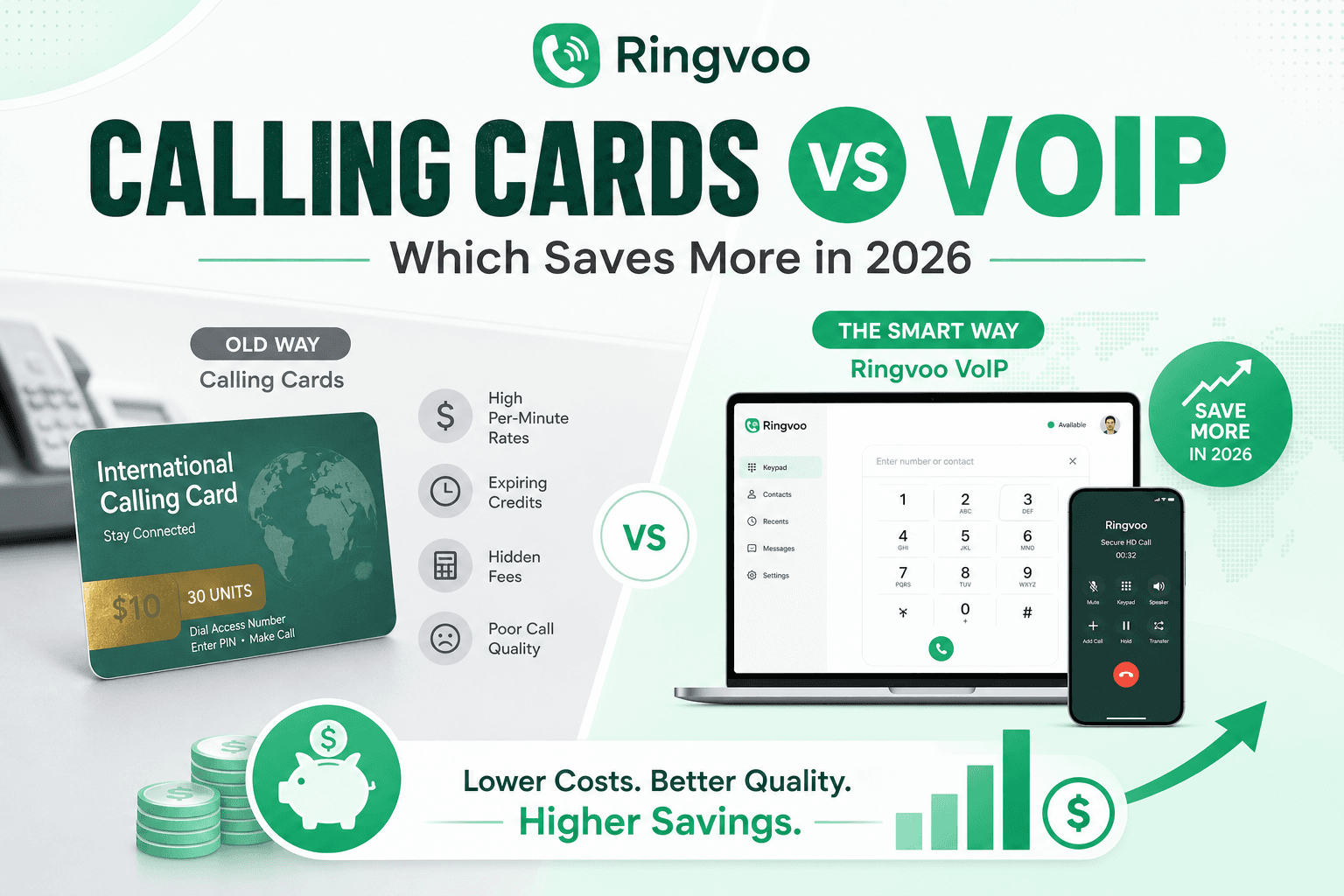
Calling cards vs VoIP is a comparison that should have ended a decade ago — yet prepaid phone cards still appear at newsagents, airport kiosks, and search ads promising "1000 international minutes for £5." In 2026, the honest answer for most regular callers is that browser-based VoIP delivers lower effective rates, fewer hidden fees, and better call quality than physical or PIN-based calling cards. The cards survive on nostalgia, tourist impulse buys, and marketing that obscures connection charges, billing increments, and expiry dates.
Ringvoo represents the modern VoIP end of this comparison: transparent per-minute rates, no connection fees, credits that do not expire, and PSTN reach to any mobile or landline from a browser tab. This guide breaks down how calling cards actually price calls, where VoIP wins on math and experience, when a card might still appear, and how to choose the cheapest option for your destinations.
Key Takeaways
- Calling cards hide cost in connection fees, 3–5 minute billing increments, maintenance charges, and PIN expiry — advertised minutes rarely match reality.
- Browser VoIP (Ringvoo) publishes per-destination rates upfront, bills per minute without connection surcharges, and keeps credits indefinitely.
- VoIP call quality typically exceeds calling cards routed through lowest-cost wholesale paths with audibly compressed audio.
- Calling cards require a phone to dial access numbers; VoIP works from any browser on Wi-Fi — no access code dance.
- See the full landscape: cheapest way to call abroad in 2026 and how expats save on international calls.
How Prepaid Calling Cards Actually Work
A traditional international calling card gives you a PIN and a local access number. You dial the access number from a landline or mobile, enter the PIN, then dial your destination in international format. The card balance decrements based on the provider's rate table — not the headline on the packaging.
Typical cost layers:
Advertised per-minute rate: The number on the card face — often the best-case rate to one destination at off-peak hours.
Connection or activation fee: A flat charge per call (15–60 seconds of balance) deducted before the conversation starts.
Billing increment: Many cards bill in 3-, 5-, or even 6-minute blocks. A 61-second call may bill as 5 minutes.
Maintenance or service fee: Weekly or monthly balance deductions whether you call or not — common on cards sold to tourists.
Expiry: PINs expire 30, 60, or 90 days after first use. Unused balance vanishes.
Access number surcharges: If you dial the access number from a mobile, your carrier may charge for that leg separately — the card does not cover it.
The result: a card advertising "1000 minutes to India" may deliver 400–600 effective minutes after fees, rounding, and access costs. Some callers report worse.
How Browser VoIP Pricing Works
Modern VoIP platforms like Ringvoo skip the access-number layer entirely. You log into a website, enter the destination in E.164 format (+91, +44, +1), and call over internet audio. The provider terminates on PSTN carrier interconnects — the recipient answers a normal phone.
Typical cost structure:
Published per-minute rate by destination and number type (mobile vs landline) — visible at Ringvoo rates before you dial.
Per-minute or per-second billing depending on provider rules — Ringvoo uses transparent minute metering without multi-minute rounding traps.
No connection fee on standard routes.
No expiry on prepaid credits.
No access number — your carrier charges nothing for a separate local dial-in leg because there isn't one.
You pay for internet (Wi-Fi at home, office, or café) plus VoIP minutes. For most expats, home broadband is already a sunk cost.
Understand the technology: what is browser calling.
Side-by-Side Comparison — Calling Cards vs VoIP
| Factor | Prepaid calling card | Browser VoIP (Ringvoo) |
|---|---|---|
| Purchase | Shop, kiosk, online PIN | Online account + credit |
| Dial process | Access number + PIN + destination | Enter +country number in browser |
| Rate transparency | Hidden fee schedule | Published per destination |
| Billing increment | Often 3–5 minutes | Per minute |
| Connection fee | Common | None |
| Credit expiry | Frequent (30–90 days) | Credits do not expire |
| Call quality | Variable — budget routes | Consistent WebRTC + wholesale PSTN |
| Device needed | Any phone for access dial | Browser on any device |
| PSTN reach | Yes (via card provider) | Yes (via carrier interconnect) |
| Works without SIM | Only if you find a free access dial | Yes — Wi-Fi only |
For the majority of international callers — expats, students, remote workers — VoIP wins on total cost of ownership, predictability, and user experience.
Hidden Calling Card Fees — Real Examples
These patterns appear repeatedly across card brands. Names change; mechanics persist.
The "first minute double" trick: First minute billed at 2–5× the advertised rate to recover margin.
The maintenance drain: £0.50–£1.00 deducted every week after activation until balance hits zero — devastating on low-denomination cards.
The mobile access trap: Card assumes landline access to local dial-in number. Mobile callers pay carrier rates for the access leg plus card minutes — never mentioned on packaging.
The destination switch: Advertised rate applies to landlines only; mobiles cost 2–3× more — buried in fine print.
The rounding cliff: 4-minute call on a 5-minute increment billing system costs 5 minutes. Six such calls waste 6 minutes of paid balance per hour of actual talk time.
VoIP eliminates most of these by design. You see the India mobile rate before dialing; you pay that rate for the minutes you use; balance remains until you spend it.
When Calling Cards Still Appear — and Why to Avoid Them
Airport impulse: Travelers without data buy cards for "emergencies." A £10 card with fees often buys fewer minutes than £10 of VoIP credit — and VoIP works on airport Wi-Fi once connected.
Gift scenarios: Relatives who are not tech-comfortable may receive cards as gifts. Better gift: add credit to a Ringvoo account and bookmark the dialer on their tablet.
Prison or institution phones: Some restricted environments only allow calls through specific prepaid systems — a niche VoIP cannot replace. This guide targets general consumers, not institutional telephony.
No internet access: If you truly have no Wi-Fi and no mobile data, a card plus payphone (where payphones still exist) is a fallback. That scenario is rare in 2026.
For everyone else, international calls without a SIM via browser VoIP is simpler and cheaper.
Switch from calling cards to browser VoIP
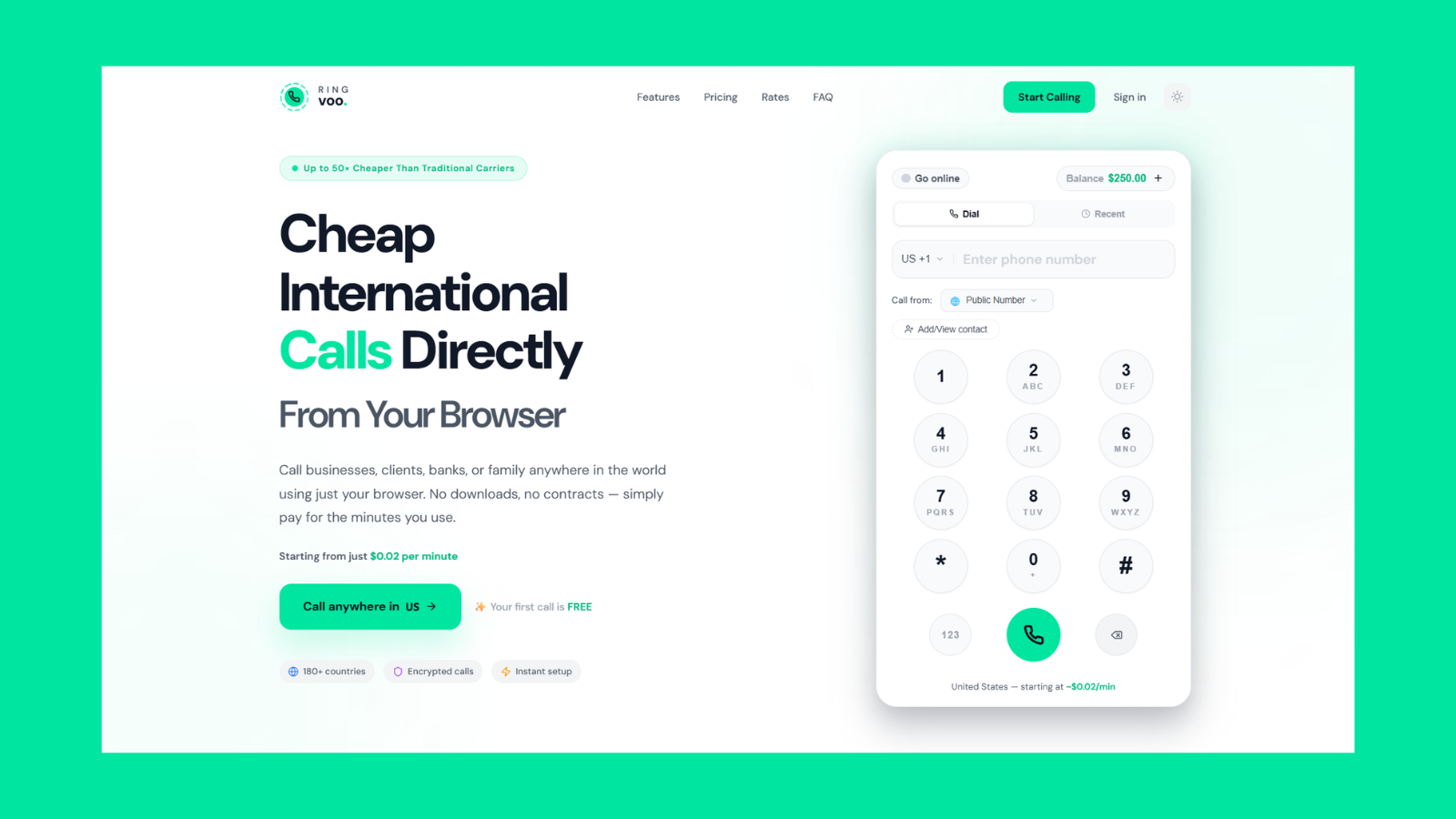
Stop dialing access numbers and entering PINs. Ringvoo shows live rates for every destination, bills per minute without connection traps, and never expires your credits. Open Chrome, log in, call.
Try Ringvoo free — call from your browser · View international rates
VoIP vs Calling Cards by Caller Profile
Daily family caller (30+ minutes/week)
Calling cards bleed balance through maintenance fees and rounding. VoIP at wholesale-backed rates wins decisively. Calculate your corridor at rates and compare to last card balance drain.
Occasional caller (1–2 calls/month)
Cards expire before you use them; VoIP credits sit until needed. VoIP wins on no expiry alone.
Multi-destination caller
Cards often advertise one cheap corridor (India, Nigeria) but punish others. VoIP publishes rates for 180+ countries in one account.
Traveler without local SIM
Cards still need a phone to dial access numbers — and that phone may roam. VoIP needs only Wi-Fi — see cheapest way to call abroad.
Business caller needing clear audio
Budget card routes compress audio aggressively. WebRTC-to-PSTN through a quality provider delivers clearer IVR navigation for bank and support lines.
Migration Checklist — From Calling Card to VoIP
- Note your top three destinations and monthly minutes per corridor.
- Find the card's effective rate including connection fees and increment rounding — divide money spent by actual minutes connected.
- Compare against Ringvoo rates for the same destinations.
- Create a free account at login and add a small credit balance.
- Test call a mobile and a landline in your primary destination.
- Bookmark the dialer on phone and laptop; retire the PIN card.
Most callers break even on the first month when maintenance fees and rounding are removed from the equation.
Calling Cards vs VoIP vs Other Methods
VoIP is not the only alternative to cards. Quick placement in the wider market:
| Method | vs calling cards | vs VoIP |
|---|---|---|
| Carrier international | More convenient, usually pricier than both | Carrier wins on zero-setup one-offs |
| Free app-to-app; no PSTN | VoIP wins for landlines and businesses | |
| Skype credit | Similar VoIP model; app required | Browser VoIP wins on friction |
| Virtual number + VoIP | Different use case (inbound) | Complementary, not competing |
See best international calling apps for broader comparisons.
Frequently Asked Questions
Are calling cards still worth it in 2026?
Rarely for regular callers. Hidden fees, expiry, and poor transparency make prepaid cards more expensive than browser VoIP for most corridors.
Is VoIP cheaper than calling cards to India?
Almost always yes when you account for connection fees, billing increments, and maintenance deductions. Compare India rates directly.
Do calling cards expire?
Most do — typically 30 to 90 days after first use. Ringvoo credits do not expire.
Can I use a calling card without a phone?
You need a phone to dial the card's access number. VoIP works from a browser without any phone for the access leg.
Is VoIP call quality better than calling cards?
Generally yes. Budget card providers use lowest-cost routes with noticeable compression. WebRTC-based VoIP typically delivers clearer audio.
Do I need to install an app for VoIP?
Not with browser-first platforms like Ringvoo. Open the website, log in, and call — see what is browser calling.
What about airport calling cards for travelers?
Airport cards carry premium pricing and short expiry. Airport Wi-Fi plus VoIP credit is usually cheaper and more flexible.
Can VoIP call landlines like calling cards?
Yes — both terminate on PSTN. The recipient answers a normal phone in either case.
Choose VoIP Over Calling Cards in 2026
Calling cards vs VoIP is not a close contest for most international callers. Cards survived on obscured pricing and tourist distribution channels. Browser pay-as-you-go VoIP — transparent rates, no expiry, no access numbers, PSTN reach worldwide — is the successor product calling cards never became.
Run your own numbers against live rates, read cheapest way to call abroad in 2026 and how expats save on international calls, then create your free Ringvoo account and retire the PIN card for good.