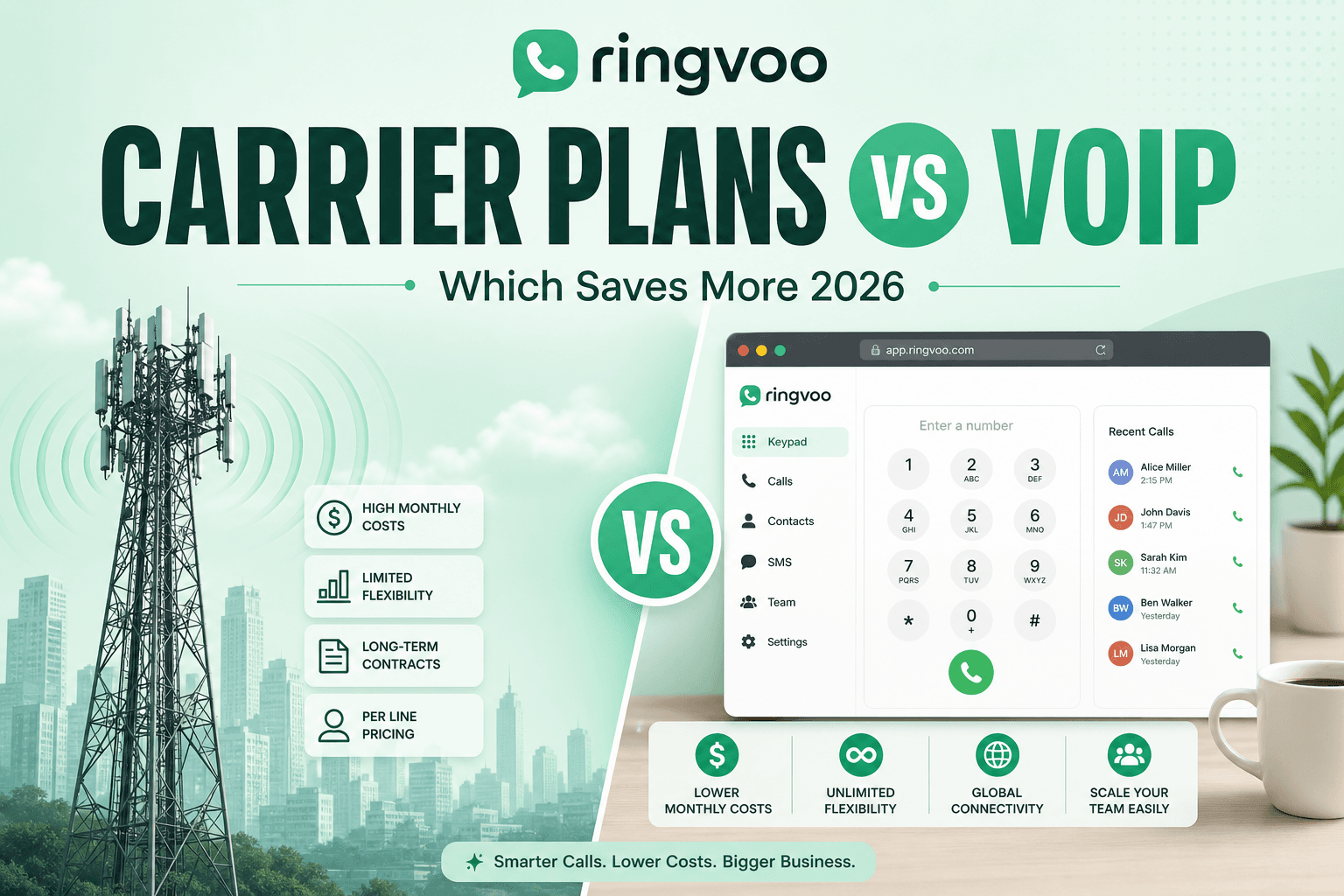
Should you keep your carrier international plan or switch to VoIP? AT&T, Verizon, T-Mobile, EE, Vodafone, and every major mobile network sell add-on packs — International Day Pass, Global Calling Plus, Roaming Passport — marketed as hassle-free calling abroad. For occasional travelers, convenience wins. For expats, remote workers, and anyone on hold with a bank or tax office weekly, carrier math rarely survives a honest calculator.
Browser-based VoIP through platforms like Ringvoo connects you to the same PSTN destinations carriers reach, usually at lower effective per-minute cost, without monthly add-on fees or fair-use throttles. This guide compares carrier international plans vs VoIP across pricing, reach, device flexibility, and real-world calling patterns in 2026.
Key Takeaways
- Carrier international packs bundle convenience, not lowest cost — audit effective per-minute price against your actual usage.
- Roaming add-ons charge premium rates for voice, data, and SMS while abroad; Wi-Fi VoIP sidesteps roaming entirely for outbound PSTN.
- Browser VoIP works on laptops and corporate devices where carrier SIM voice is your only option on phone.
- Credits that never expire beat monthly packs when call volume varies month to month.
- See full market comparison in cheapest way to call abroad 2026.
How Carrier International Plans Work
Mobile carriers monetize cross-border calling through layered products:
Domestic international add-ons (US example). AT&T International Calling packages and Verizon Global Calling add recurring monthly fees for discounted per-minute rates from the US to selected countries. You pay whether you call or not.
Roaming passes (travel example). AT&T International Day Pass, Verizon TravelPass, EE Roaming Add-ons charge daily or monthly fees to use your domestic plan allowances abroad — voice, text, and data draw from familiar buckets at surcharged effective rates.
Pay-per-use roaming. Without a pass, carriers bill voice per minute at punitive rates — $2–$3/minute is common for US carriers calling from Europe without a package.
Inclusive EU roaming (EE, Vodafone UK, EU carriers). Europeans calling within EU zones often roam at domestic rates for mobile — but calling US or Asian PSTN landlines still triggers international per-minute fees from the host network.
The pattern: carriers optimize for subscriber retention and billing simplicity, not minimum cost for 200 minutes/month to three countries.
| Carrier product (examples) | What you pay | Hidden limitation |
|---|---|---|
| AT&T Global Calling | Monthly fee + per-min | Destination list restrictions |
| Verizon TravelPass | Daily fee while roaming | Data/voice still capped |
| EE Roaming pack | Monthly add-on | Non-EU destinations extra |
| T-Mobile Stateside Intl | Plan-tier bundled | Premium destinations excluded |
| Pay-per-use roaming | No monthly fee | Extreme per-minute rates |
How Browser VoIP Differs From Carrier Voice
VoIP (Voice over IP) routes calls over the internet to a provider's gateway, then onto the PSTN — the same public phone network carriers use for termination. The difference is origination: you use Wi-Fi or data through a browser dialer instead of your SIM's voice channel.
No carrier add-on required. Log into Ringvoo on hotel Wi-Fi, office Ethernet, or mobile data. Dial + international numbers directly.
Transparent rate cards. See live per-minute rates before calling — no decoding footnotes about "included destinations" or fair-use slowdowns.
Device agnostic. Call from Windows laptop, Chromebook, iPad, or phone browser — valuable when employer MDM blocks personal SIM dual-use or travel without a local SIM.
Pay-as-you-go wallet. Add credits when needed; Ringvoo credits never expire. Quiet months cost zero beyond number rental if you use virtual inbound.
Same PSTN reach. Banks, government lines, landlines, and mobiles answer normally — unlike free messaging apps limited to same-platform users.
For roaming-specific trade-offs, read roaming vs browser calling. For legacy prepaid comparisons, see calling cards vs VoIP.
Carrier International Plan vs VoIP: Cost Scenarios
Scenario A: US expat in Germany, 90 minutes/month to US banks and family
Carrier path: Verizon TravelPass at ~$12/day on days you call, or international per-minute from German roaming at elevated rates. Effective cost easily $30–$80/month depending on call clustering.
VoIP path: 90 minutes to US at browser VoIP rates — often a few cents per minute — totals under $10/month with no daily pass. Call from apartment Wi-Fi on laptop during bank holds.
Winner: VoIP for irregular daily calling patterns.
Scenario B: UK professional, 400 minutes/month to India mobiles
Carrier path: EE international bolt-on plus per-minute India rates — evaluate bundled minutes vs overage.
VoIP path: Check India mobile rate on Ringvoo rates; multiply by 400. Heavy uniform volume may approach specialized diaspora app subscriptions — run the math.
Winner: Depends on corridor; calculate both — see expats save money on international calls.
Scenario C: Traveler, 2 emergency calls per trip
Carrier path: Pay-per-use roaming acceptable for 10 total minutes if rare.
VoIP path: Pre-load small credit balance; call from airport Wi-Fi.
Winner: Tie — VoIP still cheaper but carrier convenience marginally matters for true emergencies only.
| Monthly intl PSTN minutes | Likely winner |
|---|---|
| 0–30 (sporadic) | Browser VoIP |
| 30–150 (regular expat) | Browser VoIP |
| 150–400 (single corridor) | Calculate both |
| 400+ uniform to one country | Evaluate diaspora subscriptions |
| Laptop-primary user | Browser VoIP |
AT&T, Verizon, and EE: What Marketing Leaves Out
"Included international destinations" lists change. Promotional PDFs lag reality; verify your specific country before assuming inclusion.
Fair-use on "unlimited" roaming. Heavy data or voice while roaming can trigger throttling or carrier review even on premium plans.
Toll-free and service numbers. Some carrier international products exclude premium, toll-free, or satellite numbers — precisely the bank and government lines expats need.
Corporate phone restrictions. Work phones may block international dialing entirely. Browser VoIP on corporate laptop Wi-Fi often remains the only PSTN path — a gap carriers cannot fill.
Dual-SIM confusion. Two carriers mean two roaming policies; VoIP sidesteps which SIM owns voice routing.
Students and nomads without long-term carrier relationships should pair VoIP with international calls without a SIM instead of signing host-country postpaid contracts solely for voice.
Skip carrier add-ons — call from your browser
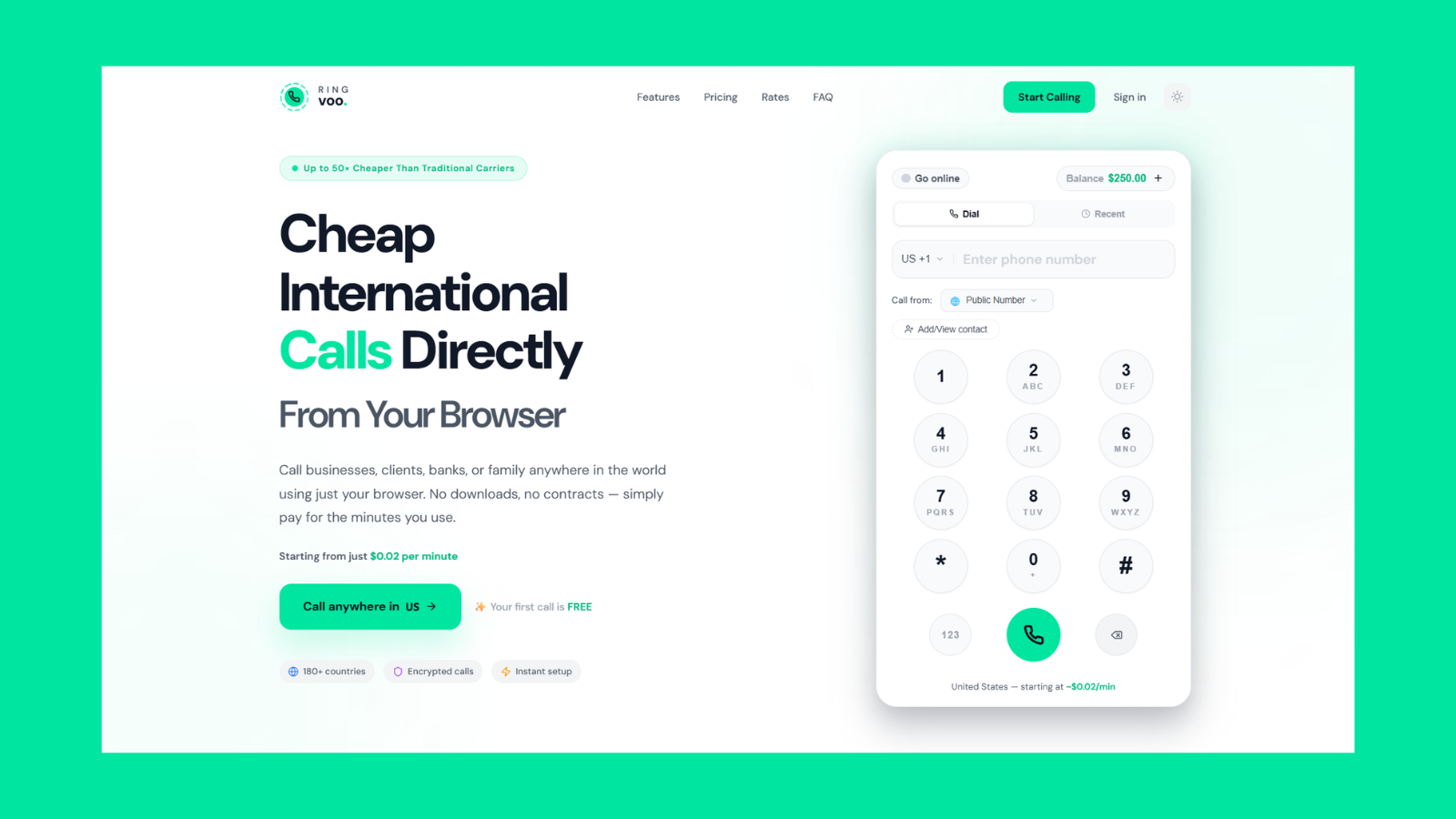
Replace expensive roaming voice with browser pay-as-you-go calling. Same PSTN destinations as AT&T, Verizon, and EE — transparent rates, credits that never expire, no monthly international pack required.
Try Ringvoo free — call from your browser · View international rates
Feature Comparison: Carrier Plans vs Browser VoIP
| Feature | Carrier intl plan | Browser VoIP (Ringvoo) |
|---|---|---|
| Monthly fixed fee | Usually yes | No (pay-as-you-go) |
| Works without SIM | No | Yes (Wi-Fi only) |
| Laptop calling | Awkward tether/hotspot | Native browser |
| Rate transparency | Bundled/ opaque | Published rate card |
| Credit rollover | Plan cycle resets | Credits never expire |
| PSTN to landlines | Yes | Yes |
| Enterprise controls | Carrier account | Enterprise option |
When Carrier Plans Still Make Sense
Honesty improves trust. Keep carrier international products when:
- You call infrequently (<15 min/month) and already carry premium plans with bundled minutes you fully consume
- You need cellular voice in areas with no Wi-Fi or data — remote driving, rural hiking
- Your employer reimburses carrier invoices uniformly regardless of optimization
- You refuse to use any internet calling on principle (rare but real)
Switch to VoIP when:
- Hold times exceed 20 minutes regularly
- You call multiple non-included destinations monthly
- You work primarily from laptop on stable Wi-Fi
- Roaming day passes trigger bill shock during multi-week travel
Migration Checklist: Carrier to VoIP
- Export three months of carrier bills — note international line items and actual minutes.
- List top five destinations — banks, family, support lines with number types (mobile vs landline).
- Compare on Ringvoo rates — multiply by historical minutes.
- Trial parallel week — place non-urgent calls via browser while keeping carrier backup.
- Cancel add-ons only after browser workflow proves stable on your networks and devices.
Cross-reference calling cards vs VoIP if you also still carry legacy prepaid cards.
Frequently Asked Questions
Is VoIP cheaper than AT&T or Verizon international plans?
For most expats with 30+ PSTN minutes monthly to varied destinations, browser pay-as-you-go VoIP costs less than roaming passes plus international add-ons. Run your specific corridor math on Ringvoo rates.
Does VoIP replace my carrier plan entirely?
No for mobile data and emergency cellular — yes for outbound international PSTN voice. Most users keep a data SIM and offload voice to Wi-Fi VoIP.
Can I call the same numbers with VoIP as with my carrier?
Browser VoIP reaches standard international PSTN numbers — mobiles, landlines, and most geographic business lines. Verify unusual premium or satellite numbers separately.
What about EE and Vodafone UK roaming in the EU?
EU roaming covers mobile usage within member states — not free calls to US or Asia PSTN lines. International per-minute fees still apply for third-country termination.
Do I need an app for browser VoIP?
Ringvoo runs in Chrome, Safari, and Edge without app store installs — unlike carrier apps that only manage billing, not cheaper voice routes.
Is call quality worse than carrier voice?
On stable Wi-Fi, WebRTC HD voice often matches or exceeds congested roaming routes. Test with a short call before canceling carrier add-ons.
Where can I read a full 2026 cost comparison?
Start with cheapest way to call abroad 2026, roaming vs browser calling, and international calls without a SIM.
Pick Carrier Convenience or VoIP Savings — Honestly
The carrier international plan vs VoIP decision is arithmetic dressed as marketing. Carriers sell peace of mind in bundled daily passes; browser VoIP sells transparent PSTN at wholesale-aligned rates without monthly autopay. For expats living on Wi-Fi, remote workers on corporate laptops, and travelers tired of day-pass sticker shock, VoIP wins most months.
Export your last carrier bill, compare against Ringvoo rates, trial a week of browser calls to your bank and family lines, and drop add-ons that no longer earn their keep. Create your free account and stop subsidizing roaming voice you could place for pennies on Wi-Fi.